Digital Product Ecosystem · 2026 · Live
The Ship It System
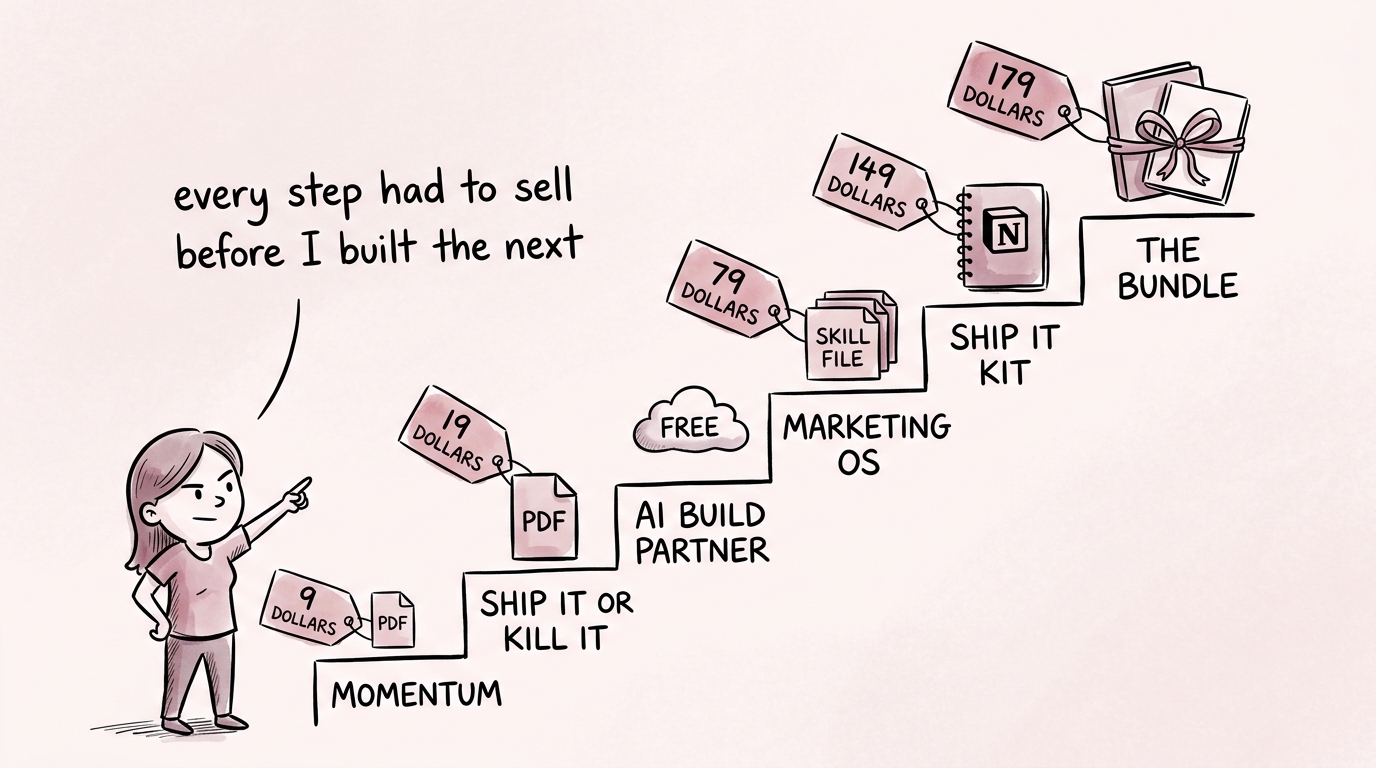
Started as a single $9 lead magnet (The Momentum Method). Eight products and 14 months later, an $1,553 stated-value bundle at $179 with the math published on /value. Built in the open. Same person, same patterns, three years.
Visit the live productFirst, the question that wouldn't quit
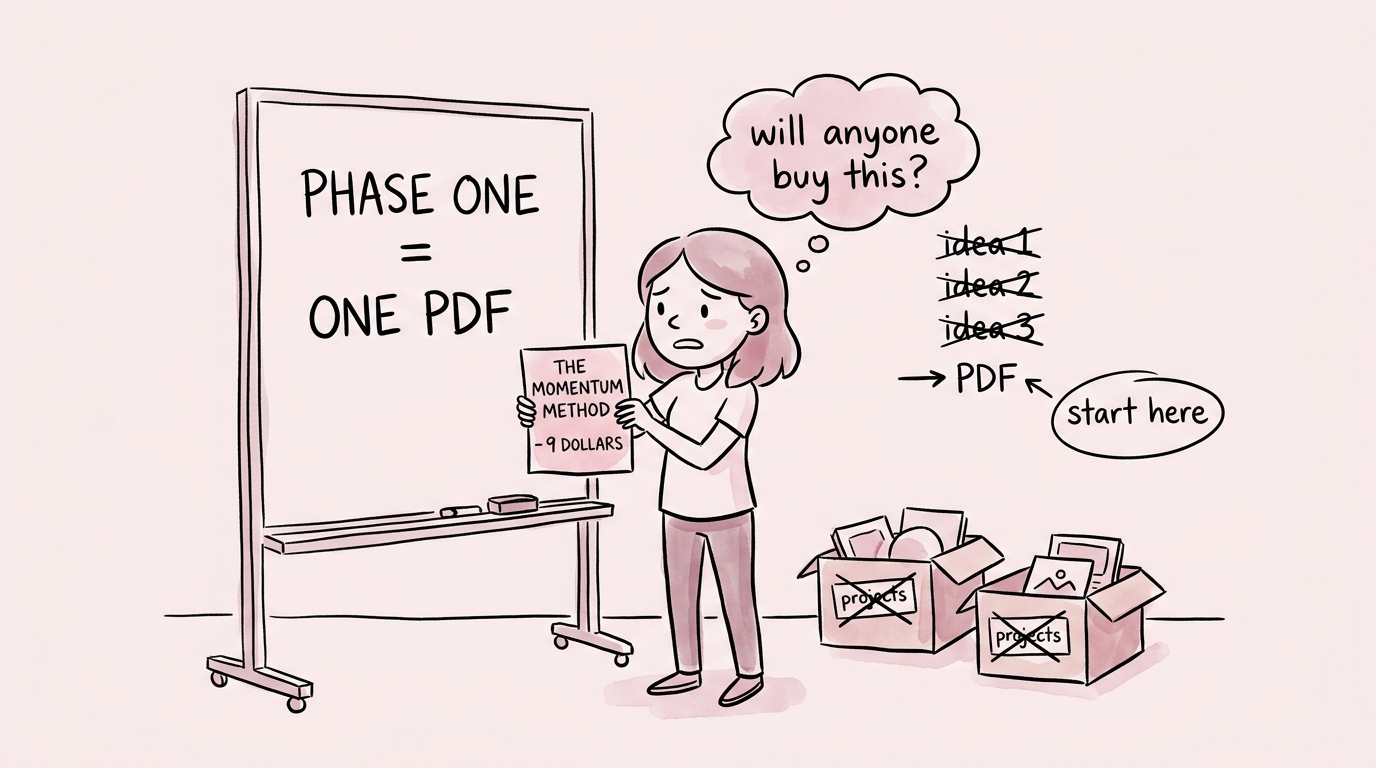
Three years of side projects. Notebooks full of ideas. A graveyard of half-finished MVPs in cardboard boxes I'd stopped opening. The question I couldn't shake at the start of 2025: would anyone actually pay me for one of these — or had I just been building things nobody wanted?
The smallest test I could think of: a $9 PDF. 21 days, one micro-habit per day to rebuild a build-loop that had decayed. No website. No funnel. No upsell. Just a tripwire on Gumroad to see if the problem was real before I built anything bigger.
Then it actually happened — and the doubt got worse
People bought it. Not many. But enough. And immediately a new doubt landed: was that a fluke? Did the first five buyers happen to be friends-of-friends? Would the next product die in the silence I'd been so used to?
One product selling proves an audience exists. It does not prove the audience is mine. The only way to know was to ship a second one and see if it sold to nobody I knew.
The second tripwire ($19) — and the proof I was looking for
If the problem is stuck projects, the next product is the kill criteria. Ship It or Kill It in 90 Days — three 4-week sprints with explicit Ship-or-Kill checkpoints. The mechanism the creator economy doesn't sell. Most courses say 'you can do it.' This one said 'you can stop doing it, with dignity.' $19 because that's where Gumroad single-issue playbooks live.
Then AI changed the math
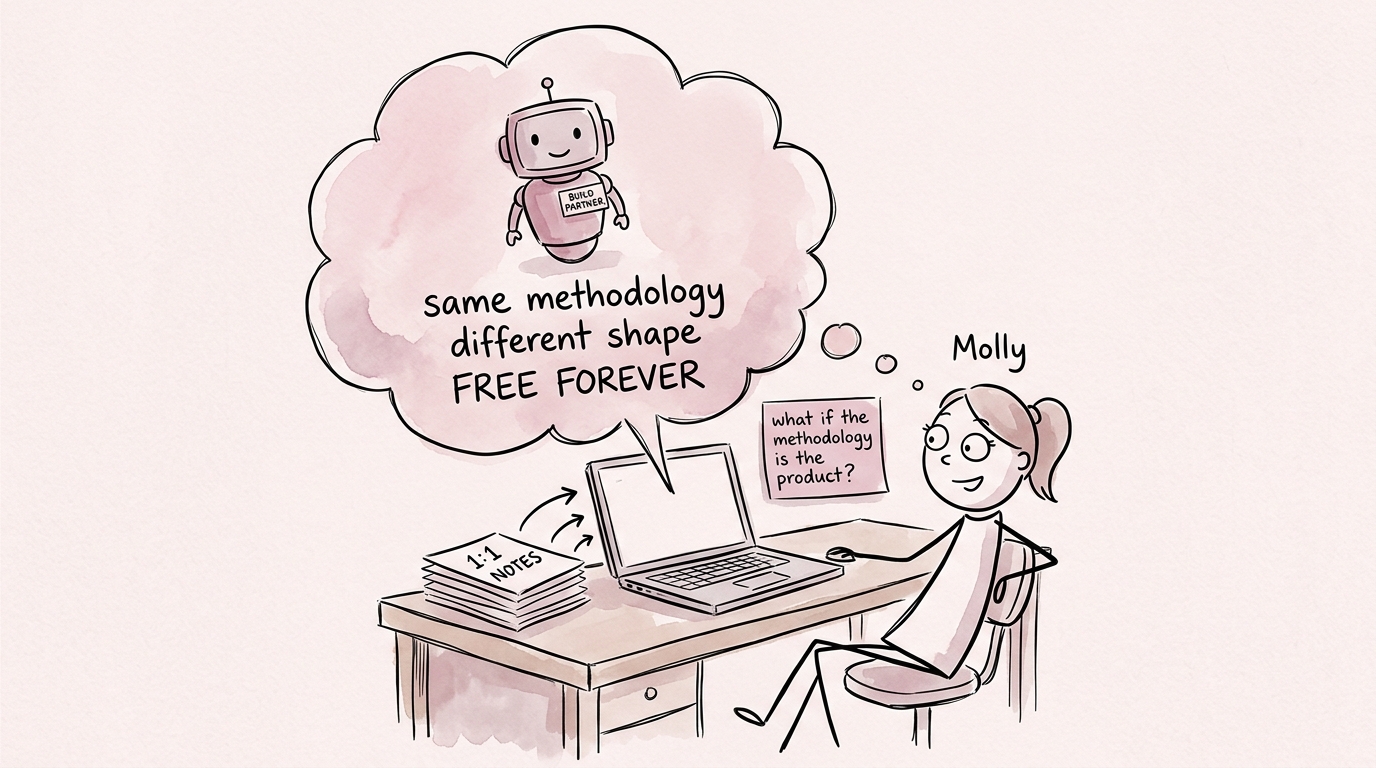
By early 2026, AI was the obvious leverage. The same frameworks that lived in the $19 PDF could live as a conversational Claude skill — one that walks five entry paths and ships Build Audit, Scope Guillotine, 10-Day Sprint, 4 Stuck Patterns as conversational templates. Free. Forever. The top-of-funnel piece that proves the methodology before anyone pays a dollar.
Most AI prompt buyers don't realize they're missing the unsexy infrastructure piece — the 10-layer system prompt that gives the AI persistent context. That's the thing that turns 'ChatGPT helped me brainstorm' into 'I have a build partner.'
Then the stack started building itself
Free Build Partner proved the methodology. Buyers who installed it kept hitting the same Day 22 wall — write the landing page. So I built Marketing OS ($79): 25 AI skills encoding Hormozi on offers, Cialdini on persuasion, Schwartz on awareness levels, Brunson on funnels, Belcher on ads. Each skill turns a 2-hour writing slog into a 5-minute conversation. Then the Kit ($149): the 90-day playbook with 25 fill-in-the-blank templates. Day 1 write your JTBD. Day 30 first sale. Day 60 PMF data.
Meanwhile — four sites, four audiences, nights and weekends
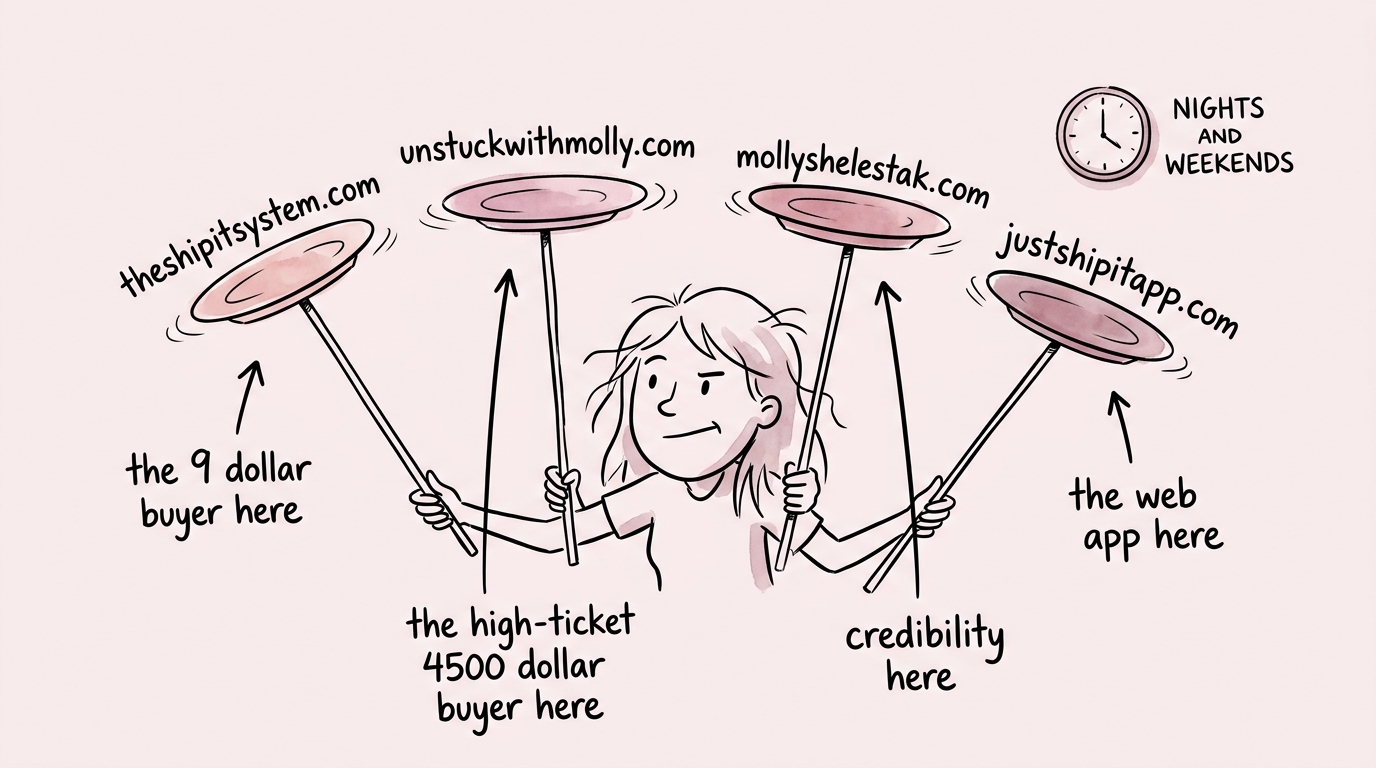
The products didn't ship on a single domain. By spring 2026 there were four live sites, each doing a different job for a different audience. Built in parallel, mostly nights and weekends, because no single funnel could serve a high-ticket 1:1 service AND a $9 PDF AND a developer-flavored web app at the same time.
Through most of 2026 these products lived primarily on Gumroad. The marketing site at theshipitsystem.com shipped in late winter as the consolidation surface — homepage, dedicated Kit page, About, demo. Soft Pink Sketch visual register (hand-drawn xkcd-style line work with selective pink watercolor washes, paper-cream cards, washi tape, Patrick Hand headlines) — chosen because every other AI thought-leadership site looks the same and the warm hand-drawn feel signals 'real human with real opinions, not a vendor.'
Four sites, four audiences. Not because four sites is the elegant answer — because each audience needs a different first impression. The high-ticket buyer can't share a homepage with the $9 buyer.
May 2026 — the proof I needed (and the math nobody could argue with)
The marketing site was working but missing one thing: a defensible answer to 'is this worth $179?' A senior tech buyer has been trained to dismiss inflated value stacks. The fix was to actually build the stack — every component priced against a named, publicly-priced competitor (Copyhackers $997, Lenny's $200/yr, Justin Welsh $150, PromptBase $9.99 ceiling, Glassdoor PM consultant rates $99/hr). Ratios held under 9× by deliberate constraint. Standard creator-economy stacks claim 5–20×.
Shipped in one working session: canonical pricing doc, three new SPS UI components (ValueStackCard, DecisionFatigueStat, CompFootnote), four surface integrations (Kit page, homepage credibility unit, new /value page, /compare hub), six honest comparison pages versus named competitors (Ship 30 for 30, Lenny's, Copyhackers, Justin Welsh, PM Collective), SEO Phase 1–3 (titles, schema, llms.txt v2), and the case study you're reading right now. 34 passing tests. 32 JSON-LD entities. Every commit public on GitHub.
What three years of compound shipping taught me
Start cheap, ship the smallest thing that can confirm the problem, then layer up. Every product on the ladder was built because the one before it sold. Nothing was built on hope.
Momentum Method ($9) made me believe the audience existed. Ship It or Kill It ($19) proved the first wasn't a fluke. The free Claude skill became the top of the funnel. Marketing OS solved the bottleneck buyers hit at Day 22. The Kit organized everything into a 90-day system. The Bundle was the math nobody could argue with. The value-stack rollout made the whole thing defensible.
Honest note
What this case study isn't.
This case study is intentionally meta — the system was used on itself, the build narrative documents the case study being written. That makes it transparently verifiable (every commit public on the GitHub repo, every product live on Gumroad) but also less generalizable than a third-party case study would be. The product line was built over three years, mostly nights and weekends, in parallel with day-job PM work at Heap/Contentsquare. None of the timeline above is hypothetical. Used The Ship It System on a real product and want to ship your own case study? Email hello@unstuckwithmolly.com.
Last updated 2026-05-17.